College Football Sim 2
- 3.4
- Rating
- 10.00K
- Installs
- Free
- Price

 Analysis by App-foxy
I went into College Football Sim 2 expecting a lightweight sports game, but its real appeal is closer to running a long-term college football program than controlling individual plays. That distinction matters. This is a game about decisions, patience, and the satisfaction of watching a plan develop, not a substitute for a fast action-focused football title.
After spending time with it, my view is fairly clear: it is most enjoyable when I treat each session as a short management exercise. I make a choice, consider the likely consequences, and then decide whether the result fits the direction I want for the team. The experience is calmer than a traditional match-based sports game, but that slower pace is also where its personality comes from.
What makes the college football simulation interesting
The central question is simple: can I build a college football dynasty? The game’s store summary frames that ambition directly, but the practical appeal comes from how it turns that idea into a series of smaller choices. Instead of relying on reflexes, I spend my attention on the broader shape of a program and on whether my decisions support a sustainable future.
You May Also Like

 Blood Strike: 2.5 Anniversary
Blood Strike’s Loadouts Turn Every Drop Into a Tactical Gamble
A close look at Blood Strike’s custom loadouts: how fast access to signature weapons reshapes its battle royale rhythm, rewards preparation, and narrows the gap between fights.

 Pandora - Music & Podcasts
Pandora’s Music Is Easy to Start, but Harder to Recover
Pandora’s strength is its low-effort path from a seed to a station. Its weak spot is how much confidence it asks you to place in connection, setup, and quiet recovery.

 8 Ball Pool
 Is Built on Rivalries, Rematches, and Routine
A close look at the rivalries, rematches, shared routines, and unanswered safety questions that turn a quick pool match into a persistent mobile community.

 Samsung Music
’s Quiet Strength Is Playing What You Already Own
Its reach comes less from spectacle than from dependable access to a personal library. That simplicity is both the app’s strongest retention engine and its ceiling.

 AccuWeather: Weather Radar
AccuWeather Review: A Quick, Clear Forecast for Everyday Decisions
For everyday plans, the best forecast is the one you can understand quickly. AccuWeather makes rain timing, radar, and local conditions easy to act on, with a few trade-offs.

 Hill Climb Racing
Why Hill Climb Racing Still Turns Crashes Into One More Run
A tiny car, a bumpy hill and one more upgrade: Hill Climb Racing keeps resurfacing because its simple chaos makes every near-miss feel personal.
More From Our News Desk



That makes it a useful fit for players who enjoy sports management more than sports action. I do not need a long uninterrupted session to get something from it. A few minutes can be enough to review the current situation, make a change, and think about what I want to try next. When I have more time, I can stay with the season and become more invested in the longer story of the team.
The game is published by Alec Jaco and sits in the sports category, although it feels more like a compact strategy simulation than a conventional arcade football game. That is not a criticism. In fact, it helps explain why someone who normally skips sports games might still find it appealing, while a player looking for direct control on the field may find it too restrained.
Its average rating is a 3.4 from around 145 ratings, with roughly 65 written reviews. I read that as a sign of a fairly specific audience rather than a universally polished experience. People who like the concept can connect with it, but the smaller scale and simulation-first design will not satisfy everyone who arrives expecting a full presentation of college football.
The strongest part is the decision-making loop
What kept me interested was the feeling that each choice belongs to a larger plan. The best way to play is not to chase an immediate result every time. I found it more rewarding to think about consistency: what kind of program am I trying to build, and does this decision move me toward that identity?
That mindset creates a useful tension between short-term success and long-term development. A quick fix can look attractive, but a dynasty is not built from isolated victories. Even when the game keeps the presentation compact, I can still create a personal narrative around the team. A difficult stretch becomes a rebuilding phase, a strong run becomes evidence that the approach is working, and a poor decision gives me a reason to adjust rather than simply restart.
One practical tip is to avoid treating every result as a final judgment on the quality of a decision. Simulation games can make a sensible plan look bad in the short term, and that uncertainty is part of the experience. I get more out of the game when I review patterns across several decisions instead of reacting emotionally to one setback.
Another useful approach is to set a clear internal objective before playing. I might focus on building a stable contender, experimenting with an aggressive strategy, or seeing how far I can take an underperforming team. Without a personal goal, the individual actions can feel disconnected. With one, even a short session has direction.
This is also where the game differs from the usual alternatives in the sports category. A traditional football title gives me immediate feedback through movement, timing, and execution. College Football Sim 2 asks me to find satisfaction in planning and outcomes. Neither style is automatically better, but they reward very different kinds of attention.
Why the compact format works on a phone
I appreciate that the game does not require the same commitment as a full console-style sports experience. It suits the kind of casual routine many people have with a phone: a short break, a commute, or a few minutes before bed. I can pick it up with a specific decision in mind rather than preparing for a complete match.
A realistic everyday scenario would be playing during a lunch break. I can check where the program stands, make one or two choices, and put the phone away without feeling that I abandoned a live contest halfway through. Later, I can return with enough context to continue. That makes the simulation easier to fit around real life than a game built around lengthy matches.
The trade-off is that the compact approach can make the experience feel less dramatic. There is no substitute for the excitement of personally controlling a decisive play. If I want noise, spectacle, and instant action, this will not deliver the same kind of energy. Its strength is convenience and reflection, not visual intensity.
The game is free, which lowers the barrier to trying it. It includes in-app purchases priced at $2.99 per item, so I would approach those purchases carefully and decide first whether the underlying management loop is enjoyable on its own. The free entry point is valuable because this is a niche style of sports game; I would rather test the rhythm myself than assume the idea will suit me.
Where the experience starts to show its limits
My main reservation is that the appeal depends heavily on enjoying the simulation itself. If I am not interested in thinking about a program over time, the game can feel thin compared with a football title that puts me directly in the action. The dynasty concept sounds broad, but the experience is still a focused mobile simulation, not a complete replacement for every part of college football fandom.
That limitation becomes more noticeable for players who need constant variety. A management loop can be absorbing when the consequences feel meaningful, but it can also become repetitive if I approach it without a personal challenge. The game rewards curiosity and patience more than rapid novelty. Someone who wants a new spectacle every few minutes should probably choose a different kind of sports game.
I also think the rating reflects a reasonable caution. A 3.4 average is not a signal that the game is unusable, but it does suggest uneven expectations. The concept may attract people who are looking for a larger, more elaborate production, and those players could be disappointed by the focused format. I would judge it as a niche simulation first, rather than comparing it with premium football games on presentation alone.
There is a second trade-off around monetization. Because the game is free to start and offers individual purchases, I would avoid spending until I understand how much the basic version holds my attention. A purchase can make sense for a player who has already settled into the game and knows exactly what would improve the experience. It makes less sense as a blind attempt to solve boredom or uncertainty about whether the genre is a fit.
The age rating is Everyone, which makes the game approachable for a broad audience. Still, “Everyone” should not be confused with “everyone will enjoy it.” The barrier here is not mature content; it is the preference for management decisions over direct football control. That is an important distinction for parents, younger players, and anyone choosing a game based on the category label alone.
Small habits that make the simulation more rewarding
I found that keeping a simple mental record of what I was trying to achieve made the game feel deeper. For example, instead of changing direction after every disappointing outcome, I could stick with one approach long enough to judge it fairly. That turns the experience into a personal experiment rather than a sequence of random reactions.
I also recommend playing in two different modes of attention. During a short session, I make only the most important decision and leave. During a longer session, I look back at the direction of the program and ask whether the current plan still makes sense. This prevents the game from becoming either a rushed checklist or an overlong commitment.
A third insight is that the dynasty idea works best when I accept imperfect seasons as part of the story. If I demand immediate dominance, the simulation loses much of its charm. The more interesting question is whether I can recognize a problem, change course, and build a stronger identity over time. That is a different reward from winning every encounter.
These habits also help reveal whether the game is right for me. If I enjoy setting goals and observing gradual progress, the limited presentation becomes easier to overlook. If I need detailed control over every football moment, no amount of patience will turn this into an action game. Knowing that before spending money or time is probably the most useful advice I can give.
Who should download it, and who should skip it
I would recommend this game to someone who enjoys sports management, alternate-season storytelling, and strategy that can be played in short bursts. It is especially suitable for a fan who likes imagining the future of a college program and making choices without needing to control every snap. The free price makes it easy to explore that style without committing immediately.
It may also work for players who normally find sports games intimidating. There is no need to master fast controls before understanding the basic appeal. The focus is on thinking through the program rather than proving quick reactions. That makes it a gentler entry point into sports simulations, provided the player is comfortable with a slower pace.
I would skip it if my priority is licensed-style presentation, dramatic match atmosphere, or hands-on action. I would also look elsewhere if I want a highly detailed management package with the breadth of a desktop simulation. College Football Sim 2 is better understood as a focused mobile experience: convenient, idea-driven, and built around the pleasure of guiding a program.
Device compatibility is reasonably broad, with a minimum operating system requirement of Android 5.1. The current version is 1.1.7, so I would still make sure my device is updated enough before installing. The number of installs is over 10 thousand, which places it among smaller mobile games rather than the mass-market sports releases most people already know.
My final view after playing
College Football Sim 2 is a focused sports management game with a clear identity. Its best quality is not spectacle but the way it encourages me to think like the person responsible for a program’s direction. I can play in short sessions, create my own goals, and enjoy the gradual story of trying to build something successful.
Its weaknesses come from that same focus. The presentation and rhythm will feel limited to anyone expecting direct football action, and the simulation can lose momentum if I do not give myself a reason to care about the next decision. The in-app purchases also make it sensible to try the free experience first and spend only when I understand what I want.
For me, the game earns a recommendation with conditions: download it if the idea of building a college football dynasty sounds more appealing than playing a match yourself. Treat it as a compact strategy game, not as a full replacement for an action football title. With that expectation, College Football Sim 2 offers a thoughtful little sports experience that is easy to fit into a day and surprisingly good at turning ordinary decisions into a personal season-long story.
FAQs for College Football Sim 2
01What is College Football Sim 2?
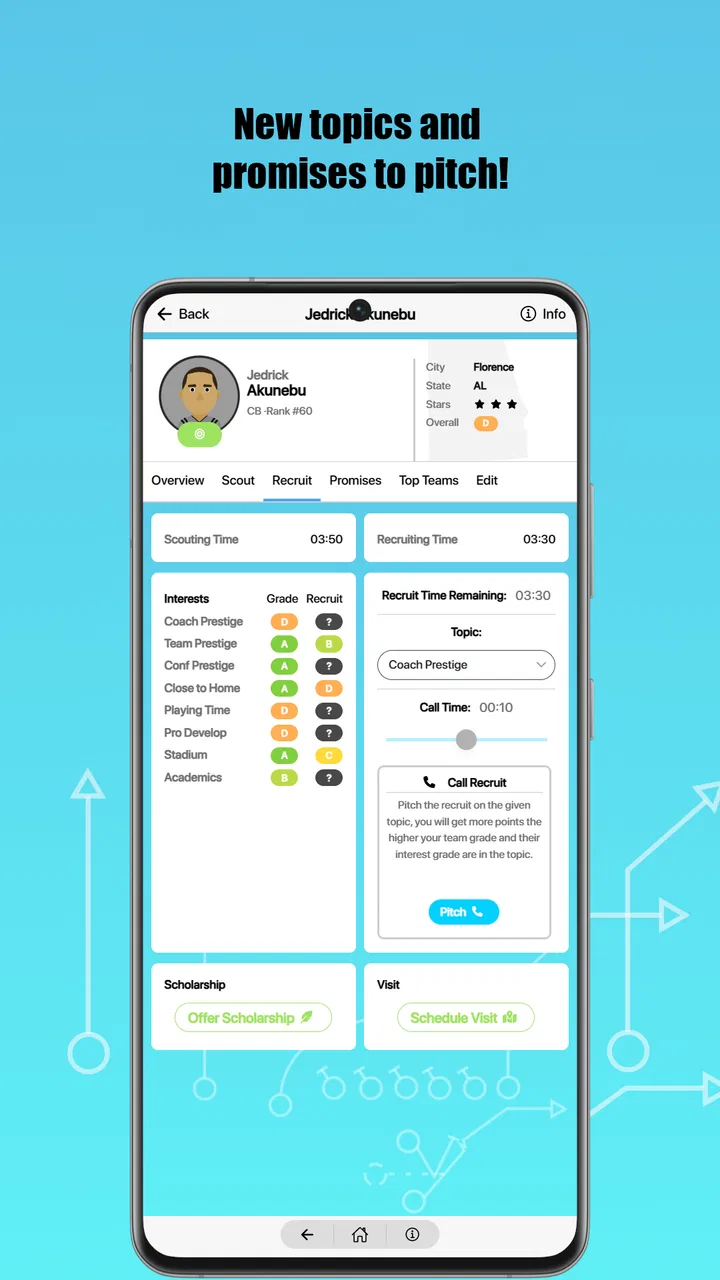
College Football Sim 2 is a management and simulation game focused on the strategy behind college football rather than direct, real-time gameplay. Players typically take control of a program, make roster and recruiting decisions, manage team development, and guide the school through a schedule and postseason competition. It is best suited to fans who enjoy planning, statistics, and long-term team building.
02How do you play College Football Sim 2?
Gameplay centers on making decisions before and during a simulated college football season. You may be responsible for recruiting prospects, setting lineups, improving player abilities, choosing tactical approaches, and managing the team’s overall progress. Matches are generally resolved through simulation, so success depends on preparation, roster quality, strategy, and how effectively you respond to the strengths and weaknesses of upcoming opponents.
03Does College Football Sim 2 include real college teams and players?
The availability of real-world teams, conferences, schools, and athletes can depend on the game’s licensing and the specific version distributed through the platform. Before downloading, check the official store description and in-game information to confirm what is included. Some simulation titles use fictional names or customizable programs, which can still provide a deep experience while avoiding official licensing restrictions.
04Can I play College Football Sim 2 offline?
Many parts of a college football management simulator may be playable without a constant internet connection, especially if you are progressing through a local career or season. However, online access may still be needed for downloading the game, receiving updates, viewing advertisements, restoring purchases, or using connected features. It is worth testing offline availability after installation rather than assuming every mode works without internet.
05Is College Football Sim 2 free to download, and does it contain purchases?
The download price and monetization model may vary between Android and iOS, so you should review the current store listing before installing. If the game is free, it may include advertising, optional purchases, or paid features that speed up progression or unlock content. Check the app’s purchase details, permissions, age rating, and privacy information to understand the full cost before committing to a long-term career.
Pros
- Deep team management and recruiting options for strategy fans.
- Offers long-term dynasty play beyond individual matchups.
- Simple interface makes most menus easy to navigate.
- Provides detailed season statistics and player progression.
- Works well for quick sessions on mobile devices.
Cons
- Limited visual presentation compared with mainstream football games.
- Learning the many management systems can take some time.
- Some features may feel repetitive during extended dynasties.
- Requires regular attention to recruiting and roster decisions.
- Appeal is limited if you prefer action-focused football gameplay.

College Football Sim 2
Gallery